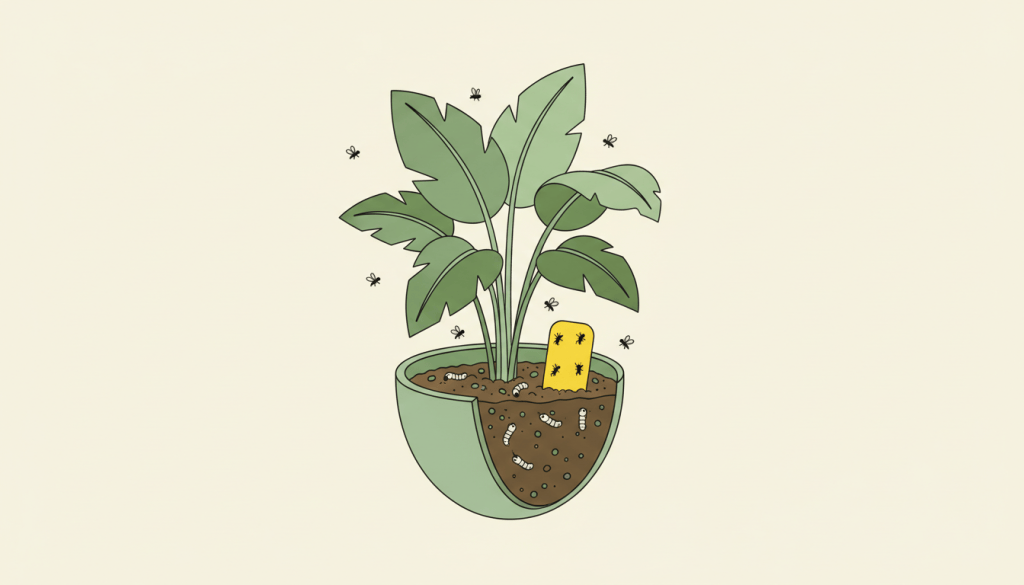
Let the top 1-2 in (2.5-5 cm) of soil dry out between waterings, hang yellow sticky traps to catch the adults, and treat the soil with a Bti-based larvae killer or beneficial nematodes. The adults are mostly a nuisance. The larvae in the soil are the real target. Keep going for 3-4 weeks to cover a full life cycle.
Here is how to get rid of fungus gnats (also called sciarid flies). The plan below goes from gentlest to most aggressive.
Are they really fungus gnats? How to tell
Adults and larvae: what to look for
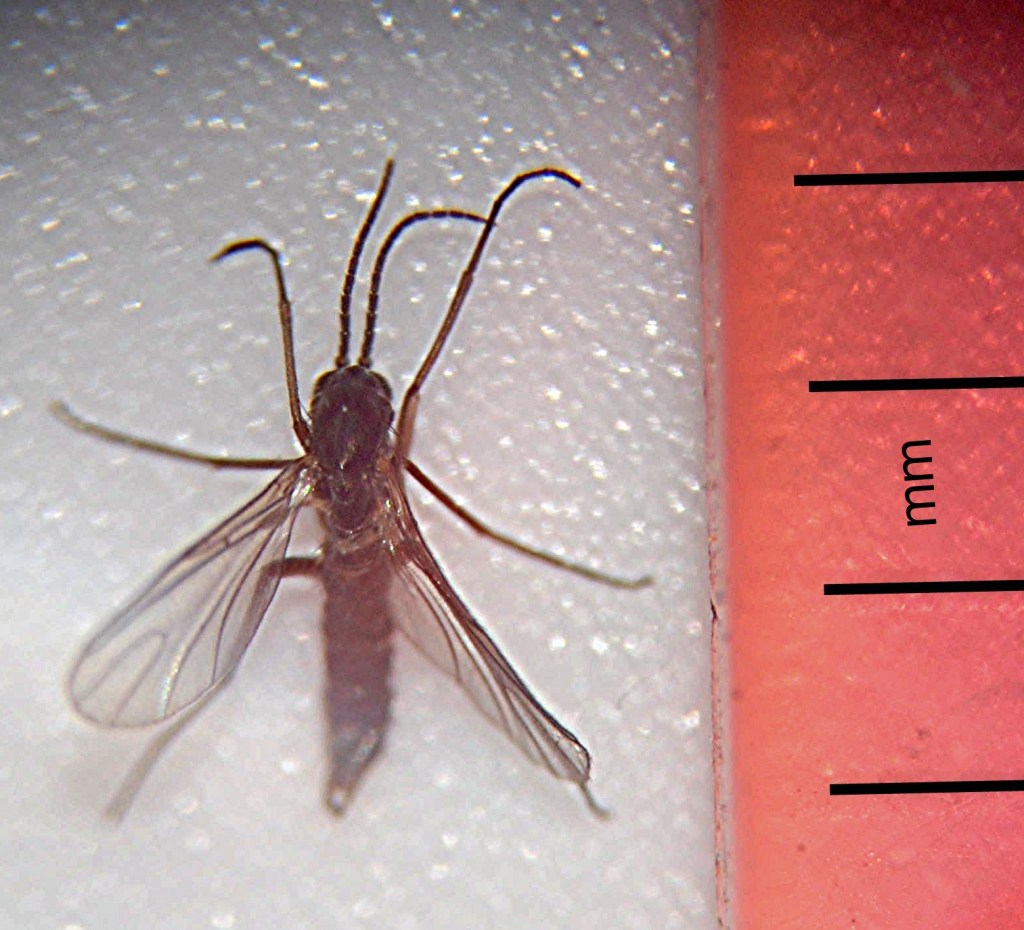
Adults are dark, delicate, mosquito-like flies about 1/8 in (3 mm) long, with long antennae. They are weak fliers that stay near plants. On the common species, a Y-shaped wing vein shows up under close inspection.
The larvae live in the soil. They are legless, whitish or translucent, with a shiny black head, and grow to about 1/4 in (6 mm).
Fungus gnat vs fruit fly vs shore fly vs drain fly vs springtail
| Insect | Look | Movement | Where you find it | Clue |
|---|---|---|---|---|
| Fungus gnat | Dark, slim, mosquito-like, long antennae | Weak, drifting flight; stays near plants | Soil surface, around pots | Pale larvae with black heads in damp soil |
| Fruit fly | Reddish-brown, clear or lightly banded wings | Drawn to fermenting fruit and veg | Ripe fruit, bins, anything fermenting | Vinegar traps catch these, not gnats |
| Shore fly | Stocky, short legs, dark wings with pale spots | Stronger, faster flier | Very wet, algae-rich spots | Algae on soil or pot surfaces |
| Drain fly | Dark gray-black, fuzzy, moth-like | Moth-like; sits with wings held roof-like | Sinks, tubs, drains | Found near sinks, tubs and drains |
| Springtail | Tiny (about 1/16-1/8 in), wingless; color varies from white to dark gray or black | Jumps several inches | Wet soil surface | No wings at all; see springtails in houseplant soil |
A fruit fly or drain fly will not respond to plant treatments. Check the bin and drains instead.
Confirm with a sticky trap or a potato slice
Stand a yellow sticky trap in the pot and see what sticks. To check for larvae, lay a skinned slice of raw potato about 1/4 in (6 mm) thick, cut side down, on the soil. Lift it after 1-4 days and look at the underside; 2 days or more gives a bigger sample.
Why you have fungus gnats
Adults lay eggs in damp soil, and larvae feed on fungi, decaying organic matter and sometimes roots. The usual suspects:
- Constantly moist potting mix. This is the main one. If you water on a fixed schedule, the soil stays wet when plants use less water.
- Autumn and winter. Shorter days and cooler rooms slow water use. Outbreaks are also common when plants return indoors after summer outside.
- New plants or damp, unsterilized mix. Unsterilized or damp mix can carry them. Fresh, houseplant-formulated mix is the safer choice.
- Poor drainage. Pots that hold water stay wet longer, which suits the larvae.
- Mold-prone soil. Fungal growth feeds larvae; see mold on houseplant soil.
Unsure if you are overwatering? See overwatering vs underwatering signs.
Are they harmful?
Adults do not bite or damage plants. Larvae can nibble roots, which matters mostly for seedlings, young plants and cuttings; established plants are unlikely to be harmed.
Gnats may carry some plant pathogens, though that evidence comes mainly from greenhouses. They do not cause root rot themselves, but the wet soil they like is also the risk factor for root rot in houseplants.
The life cycle (and why it takes weeks)
Most treatments hit only one life stage, and all four overlap. Timings vary with temperature and source, so read these as ranges.
- Egg: hatches in roughly 3-6 days. A female can lay around 100-200 or more eggs.
- Larva: feeds for roughly 10-14 days in the soil.
- Pupa: about 4-6 days before an adult emerges.
- Adult: lives roughly 7-10 days and starts laying eggs.
From egg to adult takes about 17-28 days. It is quicker in a warm room and can stretch to about a month. Hence the 3-4 weeks: eggs and pupae that survive today become tomorrow’s adults.
How to get rid of fungus gnats: least to most aggressive
Start at Step 1 and add steps rather than swapping them. In this guide (an editorial call), Steps 1, 2 and either 4 or 5 are the core; Steps 3 and 6 are optional.
Choosing Bti or nematodes: Bti is sold in pond and mosquito-control aisles, while nematodes are usually ordered online and need soil above 50 °F (10 °C). Either can work, though nematode results can be erratic; follow the label.
When to move up: if gnats still appear after consistent use of your current step, add the next one. That is editorial advice, not a sourced threshold. Consider repotting only if the soil stays soggy or roots are mushy.
| Step | Targets | Repeat | Notes |
|---|---|---|---|
| 1. Dry the soil | Eggs and larvae | Every watering | Free; the foundation |
| 2. Sticky traps | Adults | Replace when covered | Monitoring, not control |
| 3. Dry barrier | Egg-laying | Keep in place | Optional; mixed evidence |
| 4. Bti | Larvae only | Every 5-7 days, several rounds | Check local availability |
| 5. Nematodes | Larvae | Per label | Needs warm-enough soil |
| 6. Hydrogen peroxide | Unproven | Not a first step | Limited evidence |
| 7. Repot | Larvae, eggs, rotten roots | Once | Severe cases |
| Last resort: indoor spray | Adults only | Per label | Temporary |
Step 1: Let the soil dry out
This is the step that matters most. University guidance is to let the top 1-2 in (2.5-5 cm) dry between waterings, which starves eggs and larvae of the damp they need. Test with a finger before watering.
Dry only as far as the plant’s health allows. See how often to water houseplants for rhythms.
Bottom watering keeps the surface dry: stand the pot in a tray of water until the top feels slightly damp, then drain fully.
Step 2: Trap the adults
Yellow sticky traps catch adults and tell you how bad things are. On their own they do not noticeably reduce the population, and they do nothing to larvae.
Replace them when covered and keep monitoring throughout. Traps also catch other insects, and the glue calls for care around children and pets. Vinegar traps, used for fruit flies, do not work on fungus gnats.
Step 3: Add a dry barrier (optional)
Some university advice suggests a layer of coarse sand or fine grit about 1/2-1 in (1-2.5 cm) deep. The idea is that a dry surface discourages egg-laying. Sources disagree, though: one university says a sand layer is not effective. Treat it as an extra, never your only step.
Step 4: Kill larvae with Bti
Bti (Bacillus thuringiensis israelensis) is a bacterium-based product that kills fly larvae. It does not affect eggs, pupae or adults. It is often sold as a mosquito or gnat larvicide. A caterpillar product labeled simply “Bt” will not work.
Water it into the soil so it reaches the larvae. One university source suggests soaking the product in water for about 30 minutes, then drenching the soil with that water. It breaks down within a couple of days, so repeat every 5-7 days for several rounds to catch each new hatch.
Availability and rules vary by country. Check local rules and follow the label. Keep products out of reach of children and pets, and contact your vet or local poison control if anything is swallowed.
Step 5: Beneficial nematodes
These are microscopic worms (Steinernema feltiae is the one used for fungus gnats) that infect larvae in the soil. Larvae die roughly 1-2 days after infection.
Soil should be above about 50 °F (10 °C). The best range is roughly 60-70 °F (15-21 °C), and you should avoid soil above about 80 °F (27 °C). They are usually ordered online. Use them promptly, or store chilled at 38-42 °F (3-6 °C) and check the expiry date. Do not mix them with fertilizer solution.
Results can be erratic, and they do not control shore flies.
Step 6: Hydrogen peroxide (optional, limited evidence)
Hydrogen peroxide drenches are popular online, but the sources reviewed here cite no university trial, and recommended ratios contradict each other, so none is given.
If you try it, treat it as an experiment. It is a strong oxidizer: test on one plant, keep it off the leaves, and skip seedlings. Only try it after Steps 1-5 have had a fair run.
Step 7: Repot in fresh mix (severe cases)
If the soil is soggy or the plant is struggling, repotting removes larvae and eggs with the old mix. Shake off the old soil, trim soft, rotten roots, and wash the pot before refilling with fresh mix. For mushy roots, read root rot in houseplants.
Last resort: indoor insecticides
Sprays are rarely needed at home. If you use one, choose a pyrethrin or pyrethroid product labeled for indoor houseplants, applied to the plant and soil surface where adults rest, not as an air fog.
It affects adults only and relief is temporary. Pair it with the steps above, follow the label, and check local rules.
What doesn’t work well
- Cinnamon: no good evidence it works.
- Neem and diatomaceous earth: limited evidence; not proven.
- Spraying the air: the larvae stay in the soil.
- One-off treatments: they leave eggs and pupae behind.
How long until they’re gone? Treatment timeline
Plan for 3-4 weeks. One university source expects that long for changed watering plus a sand or gravel layer to bring gnats under control.
A suggested routine built from the steps above (the split by week is editorial, not a sourced schedule):
| When | What you do | What to expect |
|---|---|---|
| Today | Stop watering until the top 1-2 in (2.5-5 cm) is dry, set yellow sticky traps, confirm with a potato slice | Traps show what you have |
| This week | Start Bti (repeat every 5-7 days) or nematodes | Adults still appear; traps fill |
| Next 2-4 weeks | Keep the soil drying, repeat Bti, keep monitoring | Fewer new adults; trap catches drop |
How do you know they are gone? Editorial rule of thumb, not a sourced figure: look for no new adults on fresh traps for about two weeks, and keep monitoring past one full life cycle (17-28 days).
How to stop fungus gnats coming back
- Water by soil dryness, not the calendar. Cut back in autumn and winter. See how often to water houseplants.
- Check drainage. Use pots with holes, empty saucers after watering, and avoid pots far larger than the root ball.
- Quarantine new plants for a few weeks with a sticky trap nearby and regular inspection. See quarantine new houseplants.
- Use fresh mix. Pick fresh, houseplant-formulated mix, and avoid compost that is less than a year old.
- Keep the surface clean. Remove fallen leaves and other decaying matter.
- Keep infested plants apart rather than moving them around.
FAQ
Do fungus gnats go away on their own?
Unlikely while the soil stays wet. Drying the soil is what breaks the cycle, so changing how you water is the fix.
How long does it take to get rid of fungus gnats?
Expect about 3-4 weeks. That covers a full life cycle of roughly 17-28 days, so the next generation is dealt with too.
Are fungus gnats harmful to me, pets or plants?
Adults do not bite or damage plants. Larvae can hurt seedlings, cuttings and young plants, while established plants rarely suffer. For pets, follow product labels, keep treatments out of reach, and call your vet if anything is swallowed.
Why do fungus gnats keep coming back?
Usually the soil is staying wet, or a new plant or fresh bag of mix brought in more. Treating once and stopping early also leaves eggs and pupae to hatch. Fix the watering rhythm, then keep a trap out for a few weeks.
Does hydrogen peroxide get rid of fungus gnats?
The evidence is limited: the sources reviewed cite no university trial, and online advice on strength contradicts itself. It is not a good first step; start with drying the soil, traps, and Bti or nematodes.