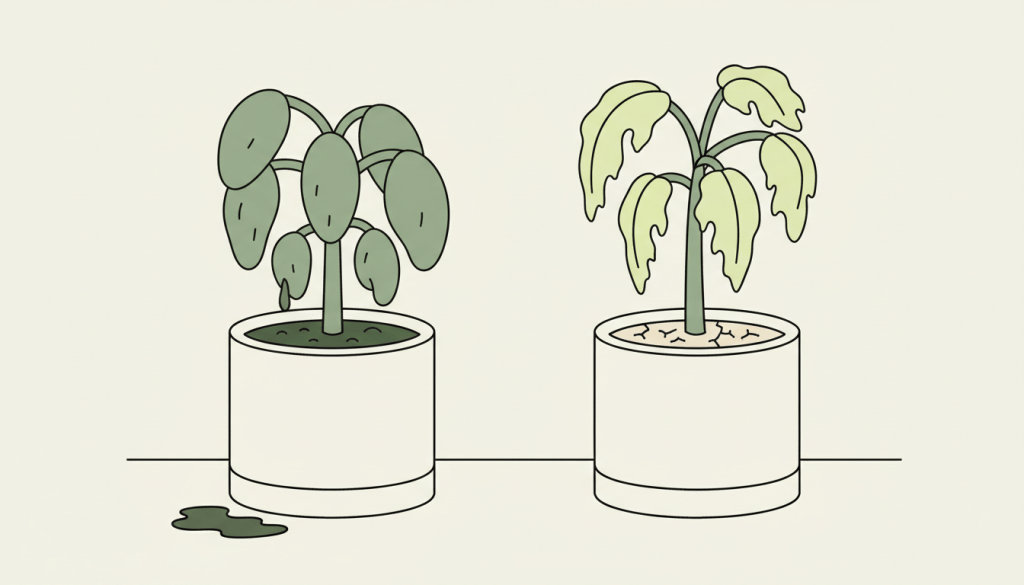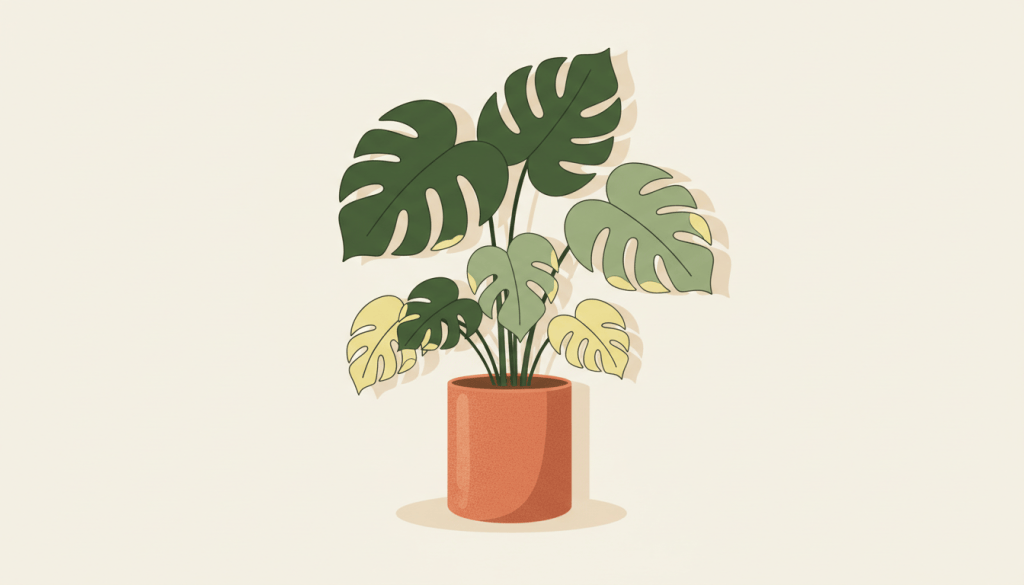
If your monstera leaves are turning yellow, check overwatering and poor drainage first, because soggy roots are one of the most common causes. Underwatering, wrong light, cold, nutrient problems, pests and repotting stress can also be behind it. One yellow lower leaf now and then is normal ageing. Use the table below to match your symptoms.
Yellowing can have more than one cause, so read the leaf, the soil and the roots together before changing anything. For the full routine, see our monstera care guide.
Quick diagnostic table: what your yellow leaves are telling you
| What you see | Likely cause | First check |
|---|---|---|
| Lower leaves yellow, soil stays wet | Overwatering or poor drainage | Push a finger 2 in / 5 cm into the soil; check the drainage holes |
| Yellow leaves, soil dry well down | Underwatering | Practical check: lift the pot; does it feel very light? |
| Pale or bleached patches on the side facing the window | Too much strong direct sun | Move the plant back and look at where the light lands |
| Tiny pale dots, bronzing or fine webbing | Spider mites | Look at leaf undersides |
| Overall pale green to yellow, often newer growth first | Nutrient shortage | When did you last feed? |
| Yellowing in a cold or drafty spot | Cold stress | Check the temperature near the plant, especially by windows and doors |
| Yellow leaves soon after repotting | Repotting stress | A few days of lower-leaf yellowing is normal; check the new pot and mix for drainage |
| One old leaf at the bottom, everything else healthy | Normal ageing | Check the soil anyway |
Why monstera leaves turn yellow
These causes are listed roughly from most to least likely. Work through them in order.
1. Overwatering and root rot
University horticulture services list waterlogged soil and damaged roots among the leading reasons for yellow leaves. Roots sitting in wet, poorly drained mix can be attacked by rot-causing organisms, which mostly strike plants that are already stressed.
How to spot it: Lower leaves turn yellow while the soil stays damp for days. Fungus gnats hovering around the pot are another sign the mix stays wet. Slide the plant out of its pot: healthy roots are firm and pale, while rotted roots are soft, dark brown or black and may smell sour.
How to fix it:
- Stop watering and empty any water from the saucer.
- If the soil is only wet, let the top 2 in / 5 cm dry out before watering again.
- If roots are mushy, remove the plant, cut away every soft, dark root with clean scissors and repot in fresh, airy mix in a pot with drainage holes. This treatment is common practice rather than a guarantee, so water sparingly afterwards and watch new growth.
- If the stem base is also rotting, you may be able to propagate a healthy node cutting to start again.
2. Underwatering
A plant that is left dry for too long can also yellow its leaves. Monstera does best when watered once the top 2 in / 5 cm is dry, so long gaps well beyond that point can stress it.
How to spot it: The soil is dry far below the surface. As a practical check, the pot may feel very light when you lift it. Curling leaves are covered separately.
How to fix it: Water thoroughly, let the excess drain, then empty the saucer. After that, check the soil rather than following a calendar. Not sure which problem you have? See overwatered vs underwatered plant.
3. Too much direct sun, or too little light
Monstera prefers bright, indirect light. Strong direct sun can scorch or bleach leaves, and moving a plant into brighter light too suddenly adds to the shock.
How to spot it: Pale, bleached or yellow patches appear on the leaves facing the window, sometimes turning into brown spots on monstera leaves.
How to fix it: Move the plant out of the direct beam, or back from the window. Make any move to brighter light gradually. If the spot is very dim, try a brighter position, but keep the light indirect.
4. Pests
Several sap-feeding pests can turn leaves yellow. Check the undersides and where the leaf stalks meet the stem.
How to spot it:
- Spider mites: tiny moving dots, bronzing and fine webbing when numerous.
- Thrips: silvery or brownish streaks and tiny black specks.
- Mealybugs: white, waxy, cottony clusters on veins, undersides and leaf joints, often with sticky residue.
- Scale: small flat or waxy bumps on stems and undersides.
How to fix it:
- Isolate the plant from your others.
- Wipe leaves with a soft brush or cloth and mild soapy water, or rinse a sturdy plant in the shower.
- If pests persist, use insecticidal soap or horticultural oil exactly as the label says, and watch for leaf damage in hot conditions.
- Keep checking the plant regularly until no pests are seen.
5. Nutrient shortage or fertilizer and salt build-up
Too little feeding and too much feeding can both look like yellowing, so check your habits first.
How to spot it: A lack of nutrients, nitrogen in particular, tends to give pale green to yellow foliage, often on newer growth first. Excess fertilizer leaves salts behind that can yellow or scorch leaves; look for a white crust on the soil surface or pot rim. Mineral-rich or softened tap water can add to the build-up.
How to fix it:
- Too little food: Feed only in the growing season (spring and summer), diluted and following the label. No fixed schedule suits every home.
- Too much food or salt: Scrape off the crust and top layer, then flush the soil by running plenty of water through the pot, at least three times the pot volume, and let it drain fully. Rainwater or filtered water can help if your tap water is mineral-rich.
6. Cold, drafts and dry air
Monstera originates in southern Mexico and Central America and prefers roughly 60-85°F / 16-29°C. The Royal Horticultural Society advises not letting it fall below 65°F / 18°C and keeping it away from cold drafts.
How to spot it: Check whether the plant sits somewhere cold or drafty, or near a heater or air conditioning vent. Dry indoor air is another stress: monstera does best at 50% humidity or higher.
How to fix it: Move the plant away from windows, doors and vents. For dry air, a humidifier, grouped plants or a pebble tray can help. University horticulture advice is that misting does little, since leaves dry quickly.
7. Repotting shock, wrong soil or a root-bound pot
Yellow or dropping lower leaves are normal for a few days after repotting. A dense mix or a pot without drainage holes can cause the same symptoms as overwatering.
How to spot it: Yellowing begins soon after a repot, or the soil stays wet for long periods in a pot that is too big or lacks holes.
How to fix it: Keep the plant in bright indirect light and skip fertilizer for at least two weeks after repotting. Use a chunky, airy mix (potting soil with bark and perlite) in a pot with drainage holes, and avoid oversized pots. Repot in early spring or at the start of your growing season (September to October in the Southern Hemisphere).
How to diagnose your monstera step by step
- Check the soil. Push a finger 2 in / 5 cm down. Wet points to overwatering, dry to underwatering.
- Check drainage. Confirm the pot has holes, the saucer is empty and the mix is not dense or waterlogged.
- Check the stem base and roots. Look for soft, dark tissue. If you suspect rot, slide the plant out and inspect the roots.
- Read the leaf pattern. Use the table above: lower leaves, edges, patches, dots or the whole plant.
- Inspect the undersides. Look for dots, webbing, cottony clusters or small bumps.
Should you cut off yellow leaves? Can they turn green again?
A fully yellow leaf rarely recovers. Fix the cause first, then watch whether new growth looks healthy.
Our guidance:
- Leave it for now if the leaf is only partly yellow, and keep watching it.
- Remove it if it is entirely yellow or crispy. As general good practice, use clean scissors, cut close to the stem and take only a few leaves at a time.
- Be cautious if many leaves yellow at once or new growth is affected. As a rule of thumb, that points to a problem with roots, water or pests, not ageing.
How to prevent yellow leaves
- Water by feel, not by calendar. Water when the top 2 in / 5 cm is dry. Soil dries more slowly in the cooler, darker months (December to February in the Northern Hemisphere, June to August in the Southern Hemisphere), so check each time.
- Use a chunky aroid mix with bark and perlite, in a pot with drainage holes.
- Give bright indirect light, out of strong direct sun.
- Keep temperatures steady at roughly 60-85°F / 16-29°C, ideally not below 65°F / 18°C, away from drafts.
- Aim for humidity of 50% or higher if your home is dry, and feed lightly in the growing season only.
If your plant is also struggling to produce split leaves, light is often involved, see monstera leaves not splitting.
When yellow leaves are normal
Older leaves yellow and drop naturally as the plant directs energy to new growth. If it is a single lower leaf, the rest of the plant looks healthy and new leaves are unfurling, it is probably ageing. Still check the soil, as lower-leaf yellowing is also a classic sign of too much water.
FAQ
Should I cut yellow leaves off my monstera?
Remove leaves that are fully yellow or crispy, using clean scissors, and a few at a time. Leave a partly yellow leaf for now and keep watching it.
Can a yellow monstera leaf turn green again?
Rarely. Once a leaf is fully yellow, it usually stays that way. Correct the cause and judge by the new growth.
Is one yellow leaf on my monstera normal?
Yes, especially an older lower leaf. Check the soil moisture to be sure, and look for other symptoms.
How often should I water a monstera?
There is no fixed schedule. Water when the top 2 in / 5 cm of soil is dry, then let the excess drain away. Expect the gaps to be longer in the cooler, darker months.
Why are my monstera leaves yellow after repotting?
Some yellowing of lower leaves is normal for a few days after repotting. Keep it in bright indirect light, avoid fertilizer for at least two weeks, and check that the new pot drains well.
For everything else your plant needs, read the monstera care guide.