Tag: root rot

  • Pothos Leaves Turning Yellow: 8 Causes, How to Diagnose Yours, and How to Fix It

    Pothos Leaves Turning Yellow: 8 Causes, How to Diagnose Yours, and How to Fix It

    Pothos leaves turning yellow most often point to overwatering and poor drainage, where soggy soil damages the roots. Underwatering, unsuitable light, normal aging, fertilizer problems and pests come next. Check the soil 1-2 in (2.5-5 cm) down and look at the roots first. Fully yellow leaves rarely turn green again, so fix the cause rather than the leaf.

    Want the fast route? Jump to the symptom table. For the full routine, see our pothos care guide.

    Quick symptom checker

    Match what you see to the most likely cause, then read the matching section below.

    What you seeMost likely causeFirst thing to do
    Several leaves yellow, soft or limp, soil still wetOverwatering or poor drainageStop watering and check the roots
    Leaves dry or curling, soil dry and pot lightUnderwateringSoak thoroughly, let it drain
    Whole plant pale, slow growth, long gaps between leavesToo little lightMove to bright indirect light
    Bleached or scorched patches on leaves facing the windowToo much direct sunPull back from the glass
    One oldest leaf yellow, new growth healthyNatural agingRemove the leaf, change nothing
    Older leaves evenly pale, slow growthHunger for nutrientsFeed lightly in the growing season
    White crust on soil, yellowing or brown tipsFertilizer salt build-upFlush the pot
    Webbing, cottony bits or sticky residuePestsIsolate and treat
    Pale or yellow leaves after a cold night or near a ventPossible cold or draft damageMove somewhere warmer

    The causes, ranked from most to least likely

    Water-related problems usually top the list. Ranking comes from what care guides report, not a measured count. Only the first place is clearly backed by sources, and beyond it the order is a judgment call, so treat it as a starting point.

    1. Overwatering and poor drainage (including root rot)

    This is the usual suspect. The Royal Horticultural Society names overwatering, which leads to root rot, as the most common pothos problem. Wet soil starves roots of air, and the leaves show it.

    Look for several yellow leaves at once, soft or limp growth, soil that stays wet for days after watering, dark mushy stems or a foul smell. Limp leaves can also be a separate worry, so see why your pothos is drooping.

    How to fix it:

    • Stop watering and slide the plant out of its pot.
    • Healthy roots are firm and pale. Rotted roots are soft, dark brown or black.
    • Cut away the rotted parts with clean scissors.
    • Repot into fresh potting mix that drains well, in a pot with drainage holes.

    A plant can often be saved if some firm roots remain. Severe rot may be fatal, and fungicides are generally not recommended for houseplants. Root rot is caused by water molds and fungi such as Pythium or Phytophthora, which thrive in waterlogged soil.

    2. Underwatering or long dry gaps

    Too little water can give a different picture: leaves that dry out or curl, soil that feels dry and a pot that feels light. For a full side-by-side comparison, see overwatered vs underwatered plant. If tips also turn crisp, read about brown leaves on a pothos.

    The fix is a thorough soak until water runs out of the drainage holes, then let it drain fully. After that, use one simple rule: water when the top 1-2 in (2.5-5 cm) of soil is dry, and wait longer in low light or in the cooler, darker months. No source supports a fixed calendar, so let the soil decide.

    3. Wrong light

    Low light mostly shows up as slower growth, faded variegation and pale leaves. Whether it directly causes yellowing is less clear, so rule out watering first. Stretched, sparse vines are a sign of the same problem, and our leggy pothos guide covers that.

    Direct summer sun has the opposite effect and can scorch leaves, especially light-colored cultivars. Aim for medium to bright indirect light. A spot a little back from a bright window usually works.

    4. Natural aging

    An old leaf near the base can yellow and drop while new growth keeps coming. That is the plant moving energy to younger leaves. One or two at a time is normal. See the normal yellowing section below.

    5. Fertilizer problems

    Too much fertilizer causes salt build-up: a white crust on the soil or pot rim, brown tips and slowed growth, and leaves may yellow. Too little can pale the oldest leaves first, because the plant moves nitrogen to new growth.

    To flush salts, scrape off the surface crust, then run water through the pot, at least 2-3 times its volume, letting it drain fully. Afterwards, feed diluted or at label rate every 1-2 months in the growing season only. Mineral build-up from tap water may also contribute, so rainwater or filtered water is an option in hard-water areas.

    6. Pests

    Pothos can get mealybugs and spider mites. Check under leaves and in the joints where leaves meet stems.

    • Mealybugs: white, powdery or cottony clusters and sticky residue.
    • Spider mites: fine webbing, yellowing and stunted growth.
    • Scale: stationary brown bumps with sticky residue.

    Isolate the plant. Wipe pests off with isopropyl alcohol on cotton or spray insecticidal soap. Repeat after about 7-10 days and keep checking, since one round often misses eggs.

    7. Cold or draft stress

    Pothos is happiest at roughly 65-85°F (18-29°C). Keep it above about 55°F (13°C) and away from cold drafts, vents and heat sources. Cold or draft damage may show up as pale or yellow leaves, so check where the plant sits.

    Ordinary household humidity is fine. Low humidity mainly causes crispy tips, not yellowing.

    8. Root-bound plant or tired soil

    Roots circling the pot or poking out of the drainage holes mean the plant has outgrown its home. Repot every 1-3 years depending on growth, going up one pot size, roughly 1-2 in (2.5-5 cm) wider. A cramped pot can stress the plant and may contribute to yellowing, but an oversized pot holds wet soil for too long, so resist going bigger.

    A rarer cause: ethylene gas from ripening fruit or a faulty gas heater can yellow leaves, though the evidence comes from greenhouses, not homes. It is unlikely, so check everything else first.

    How to diagnose your pothos in 5 steps

    1. Read the pattern. Note which leaves are affected (old or new), how many, and whether they feel soft or crisp.
    2. Test the soil. Push a finger 1-2 in (2.5-5 cm) into the soil and lift the pot. Both are useful guides, though weight misleads with large, heavy pots.
    3. Check drainage. Confirm the pot has drainage holes and that no water sits in the saucer.
    4. Check light and temperature. Look at where the plant sits: direct sun, a dim corner, a vent, a cold windowsill.
    5. Inspect roots, stems and leaf undersides. Slide the plant out. Firm pale roots are healthy; soft dark roots are not. Look for pests while you are there.

    How to fix it

    Work in order: fix the cause, then tidy the plant.

    1. Correct watering, light or temperature first.
    2. Treat roots or pests if you found them.
    3. Remove fully yellow leaves, since they rarely recover.
    4. Leave partly yellow leaves a while if they still look useful.

    Recovery takes patience. New growth may take several weeks once conditions are right, and slower in winter. Fully yellow leaves rarely turn green again, but leaves just starting to pale may recover if you act early.

    How to stop pothos leaves turning yellow again

    • Water by the soil, not the calendar: top 1-2 in (2.5-5 cm) dry first.
    • Use a pot with drainage holes and well-draining mix.
    • Empty the saucer within 15-30 minutes of watering.
    • Give medium to bright indirect light.
    • Feed lightly every 1-2 months in the growing season, and little or none in winter.
    • Repot every 1-3 years, one size up.
    • Water less in the cooler, darker months.
    • Keep it above about 55°F (13°C) and away from vents.

    More on all of this is in our pothos care guide.

    When yellow leaves are normal

    Not every yellow leaf is a problem.

    • One old lower leaf yellowing now and then is ordinary.
    • Neon pothos is lime-green by nature, and Marble Queen has cream and white variegation, so those colors are not damage.
    • Growth slows in the cooler, darker months, so a leaf or two may go.
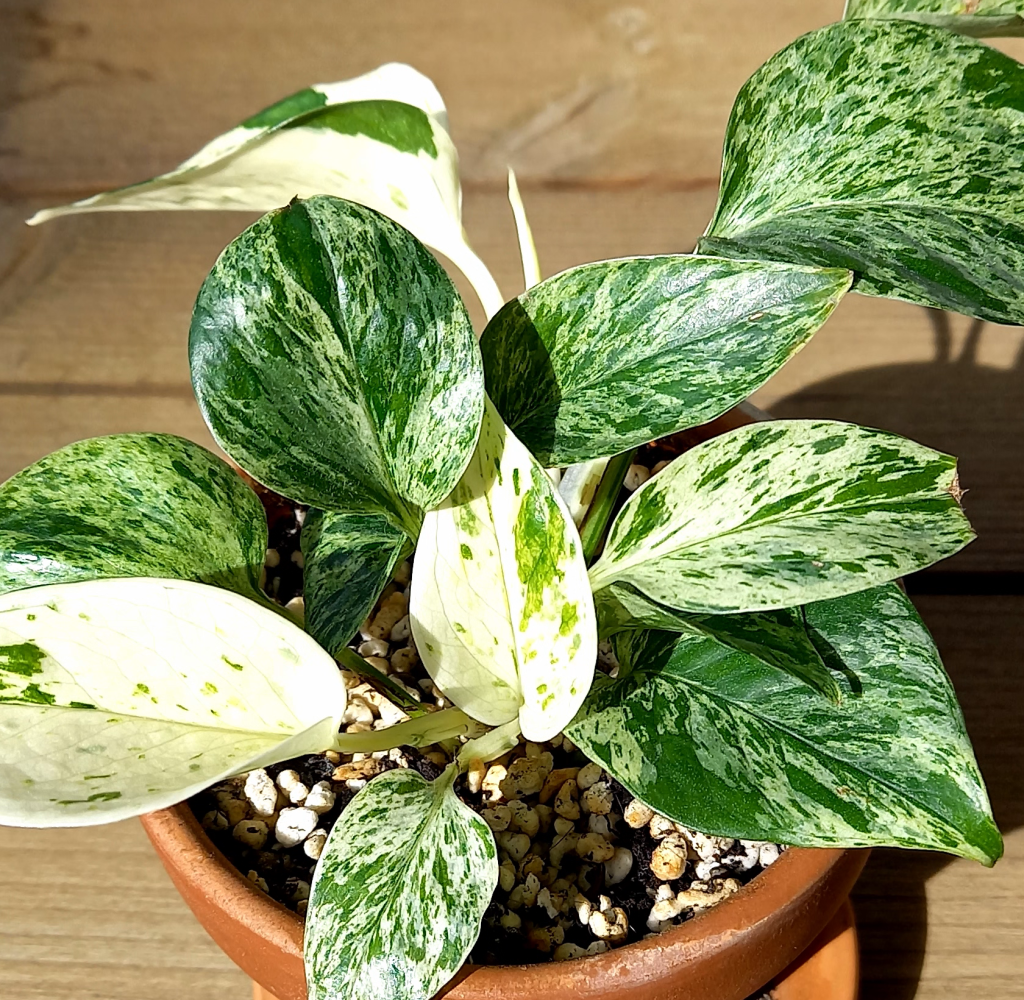
    Marble Queen pothos with cream and green variegated leaves growing in a small terracotta pot
    A healthy Marble Queen pothos. Its cream and white variegation is natural, not damage. Photo: Spnq, CC BY-SA 4.0, via Wikimedia Commons.

    When to worry: several leaves yellowing at once, or yellowing that spreads quickly. Then work through the five steps above.

    FAQ

    Should I cut off yellow pothos leaves?

    Yes, once a leaf is fully yellow, because it rarely recovers. Use clean scissors and cut at the base of the leaf stalk. Leave leaves that are only slightly pale for now. They may improve once the cause is fixed.

    Can yellow pothos leaves turn green again?

    Fully yellow leaves rarely turn green again. A leaf that is just beginning to pale may regain color if you correct the cause quickly. Focus on protecting new growth, which should look healthier once watering, light and temperature are right.

    How can I tell overwatering from underwatering?

    Check the soil and the leaf feel. Overwatered plants have wet soil and soft, limp yellow leaves. Underwatered plants have dry soil, a light pot and dry, curling leaves. Our guide to overwatered vs underwatered plant puts the differences side by side.

    Why is only the bottom leaf of my pothos yellow?

    A single yellow leaf at the base while the rest looks healthy is usually natural aging. The plant sends energy to new growth. If more leaves follow quickly, or new growth looks poor, check watering and roots using the five steps.

    Can a pothos recover from root rot?

    Often, if some firm roots remain. Trim away soft, dark roots, repot in fresh well-draining mix with drainage holes, and water only when the top 1-2 in (2.5-5 cm) is dry. Severe rot may be fatal, so act early. Firm, pale roots are a good sign.

    For the rest of pothos care, head back to the pothos care guide.
  • Monstera Leaves Turning Yellow: 7 Causes and How to Fix Each

    Monstera Leaves Turning Yellow: 7 Causes and How to Fix Each

    If your monstera leaves are turning yellow, check overwatering and poor drainage first, because soggy roots are one of the most common causes. Underwatering, wrong light, cold, nutrient problems, pests and repotting stress can also be behind it. One yellow lower leaf now and then is normal ageing. Use the table below to match your symptoms.

    Yellowing can have more than one cause, so read the leaf, the soil and the roots together before changing anything. For the full routine, see our monstera care guide.

    Quick diagnostic table: what your yellow leaves are telling you

    What you seeLikely causeFirst check
    Lower leaves yellow, soil stays wetOverwatering or poor drainagePush a finger 2 in / 5 cm into the soil; check the drainage holes
    Yellow leaves, soil dry well downUnderwateringPractical check: lift the pot; does it feel very light?
    Pale or bleached patches on the side facing the windowToo much strong direct sunMove the plant back and look at where the light lands
    Tiny pale dots, bronzing or fine webbingSpider mitesLook at leaf undersides
    Overall pale green to yellow, often newer growth firstNutrient shortageWhen did you last feed?
    Yellowing in a cold or drafty spotCold stressCheck the temperature near the plant, especially by windows and doors
    Yellow leaves soon after repottingRepotting stressA few days of lower-leaf yellowing is normal; check the new pot and mix for drainage
    One old leaf at the bottom, everything else healthyNormal ageingCheck the soil anyway
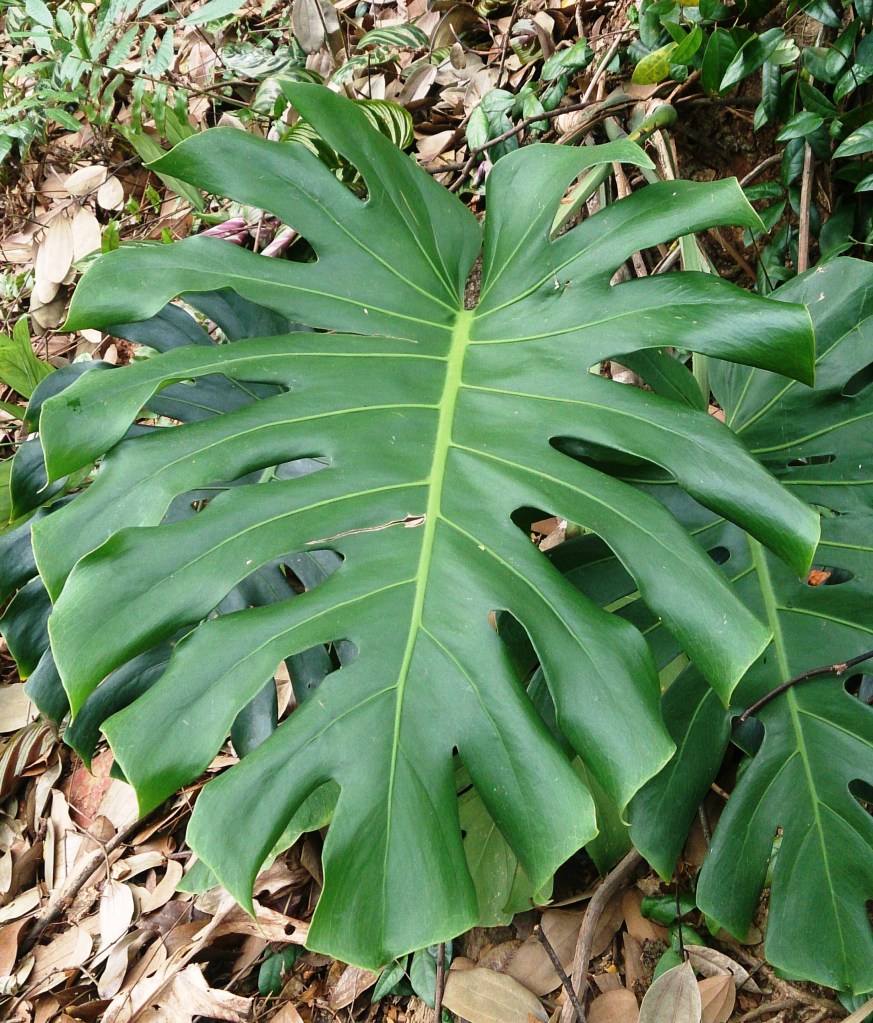
    A large, deep green monstera deliciosa leaf with deep splits and no yellowing
    A healthy monstera leaf: even deep green with no yellowing. Photo: Mokkie, CC BY-SA 3.0, via Wikimedia Commons.

    Why monstera leaves turn yellow

    These causes are listed roughly from most to least likely. Work through them in order.

    1. Overwatering and root rot

    University horticulture services list waterlogged soil and damaged roots among the leading reasons for yellow leaves. Roots sitting in wet, poorly drained mix can be attacked by rot-causing organisms, which mostly strike plants that are already stressed.

    How to spot it: Lower leaves turn yellow while the soil stays damp for days. Fungus gnats hovering around the pot are another sign the mix stays wet. Slide the plant out of its pot: healthy roots are firm and pale, while rotted roots are soft, dark brown or black and may smell sour.

    How to fix it:

    1. Stop watering and empty any water from the saucer.
    2. If the soil is only wet, let the top 2 in / 5 cm dry out before watering again.
    3. If roots are mushy, remove the plant, cut away every soft, dark root with clean scissors and repot in fresh, airy mix in a pot with drainage holes. This treatment is common practice rather than a guarantee, so water sparingly afterwards and watch new growth.
    4. If the stem base is also rotting, you may be able to propagate a healthy node cutting to start again.

    2. Underwatering

    A plant that is left dry for too long can also yellow its leaves. Monstera does best when watered once the top 2 in / 5 cm is dry, so long gaps well beyond that point can stress it.

    How to spot it: The soil is dry far below the surface. As a practical check, the pot may feel very light when you lift it. Curling leaves are covered separately.

    How to fix it: Water thoroughly, let the excess drain, then empty the saucer. After that, check the soil rather than following a calendar. Not sure which problem you have? See overwatered vs underwatered plant.

    3. Too much direct sun, or too little light

    Monstera prefers bright, indirect light. Strong direct sun can scorch or bleach leaves, and moving a plant into brighter light too suddenly adds to the shock.

    How to spot it: Pale, bleached or yellow patches appear on the leaves facing the window, sometimes turning into brown spots on monstera leaves.

    How to fix it: Move the plant out of the direct beam, or back from the window. Make any move to brighter light gradually. If the spot is very dim, try a brighter position, but keep the light indirect.

    4. Pests

    Several sap-feeding pests can turn leaves yellow. Check the undersides and where the leaf stalks meet the stem.

    How to spot it:

    • Spider mites: tiny moving dots, bronzing and fine webbing when numerous.
    • Thrips: silvery or brownish streaks and tiny black specks.
    • Mealybugs: white, waxy, cottony clusters on veins, undersides and leaf joints, often with sticky residue.
    • Scale: small flat or waxy bumps on stems and undersides.

    How to fix it:

    1. Isolate the plant from your others.
    2. Wipe leaves with a soft brush or cloth and mild soapy water, or rinse a sturdy plant in the shower.
    3. If pests persist, use insecticidal soap or horticultural oil exactly as the label says, and watch for leaf damage in hot conditions.
    4. Keep checking the plant regularly until no pests are seen.

    5. Nutrient shortage or fertilizer and salt build-up

    Too little feeding and too much feeding can both look like yellowing, so check your habits first.

    How to spot it: A lack of nutrients, nitrogen in particular, tends to give pale green to yellow foliage, often on newer growth first. Excess fertilizer leaves salts behind that can yellow or scorch leaves; look for a white crust on the soil surface or pot rim. Mineral-rich or softened tap water can add to the build-up.

    How to fix it:

    • Too little food: Feed only in the growing season (spring and summer), diluted and following the label. No fixed schedule suits every home.
    • Too much food or salt: Scrape off the crust and top layer, then flush the soil by running plenty of water through the pot, at least three times the pot volume, and let it drain fully. Rainwater or filtered water can help if your tap water is mineral-rich.

    6. Cold, drafts and dry air

    Monstera originates in southern Mexico and Central America and prefers roughly 60-85°F / 16-29°C. The Royal Horticultural Society advises not letting it fall below 65°F / 18°C and keeping it away from cold drafts.

    How to spot it: Check whether the plant sits somewhere cold or drafty, or near a heater or air conditioning vent. Dry indoor air is another stress: monstera does best at 50% humidity or higher.

    How to fix it: Move the plant away from windows, doors and vents. For dry air, a humidifier, grouped plants or a pebble tray can help. University horticulture advice is that misting does little, since leaves dry quickly.

    7. Repotting shock, wrong soil or a root-bound pot

    Yellow or dropping lower leaves are normal for a few days after repotting. A dense mix or a pot without drainage holes can cause the same symptoms as overwatering.

    How to spot it: Yellowing begins soon after a repot, or the soil stays wet for long periods in a pot that is too big or lacks holes.

    How to fix it: Keep the plant in bright indirect light and skip fertilizer for at least two weeks after repotting. Use a chunky, airy mix (potting soil with bark and perlite) in a pot with drainage holes, and avoid oversized pots. Repot in early spring or at the start of your growing season (September to October in the Southern Hemisphere).

    How to diagnose your monstera step by step

    1. Check the soil. Push a finger 2 in / 5 cm down. Wet points to overwatering, dry to underwatering.
    2. Check drainage. Confirm the pot has holes, the saucer is empty and the mix is not dense or waterlogged.
    3. Check the stem base and roots. Look for soft, dark tissue. If you suspect rot, slide the plant out and inspect the roots.
    4. Read the leaf pattern. Use the table above: lower leaves, edges, patches, dots or the whole plant.
    5. Inspect the undersides. Look for dots, webbing, cottony clusters or small bumps.

    Should you cut off yellow leaves? Can they turn green again?

    A fully yellow leaf rarely recovers. Fix the cause first, then watch whether new growth looks healthy.

    Our guidance:

    • Leave it for now if the leaf is only partly yellow, and keep watching it.
    • Remove it if it is entirely yellow or crispy. As general good practice, use clean scissors, cut close to the stem and take only a few leaves at a time.
    • Be cautious if many leaves yellow at once or new growth is affected. As a rule of thumb, that points to a problem with roots, water or pests, not ageing.

    How to prevent yellow leaves

    • Water by feel, not by calendar. Water when the top 2 in / 5 cm is dry. Soil dries more slowly in the cooler, darker months (December to February in the Northern Hemisphere, June to August in the Southern Hemisphere), so check each time.
    • Use a chunky aroid mix with bark and perlite, in a pot with drainage holes.
    • Give bright indirect light, out of strong direct sun.
    • Keep temperatures steady at roughly 60-85°F / 16-29°C, ideally not below 65°F / 18°C, away from drafts.
    • Aim for humidity of 50% or higher if your home is dry, and feed lightly in the growing season only.

    If your plant is also struggling to produce split leaves, light is often involved, see monstera leaves not splitting.

    When yellow leaves are normal

    Older leaves yellow and drop naturally as the plant directs energy to new growth. If it is a single lower leaf, the rest of the plant looks healthy and new leaves are unfurling, it is probably ageing. Still check the soil, as lower-leaf yellowing is also a classic sign of too much water.

    FAQ

    Should I cut yellow leaves off my monstera?

    Remove leaves that are fully yellow or crispy, using clean scissors, and a few at a time. Leave a partly yellow leaf for now and keep watching it.

    Can a yellow monstera leaf turn green again?

    Rarely. Once a leaf is fully yellow, it usually stays that way. Correct the cause and judge by the new growth.

    Is one yellow leaf on my monstera normal?

    Yes, especially an older lower leaf. Check the soil moisture to be sure, and look for other symptoms.

    How often should I water a monstera?

    There is no fixed schedule. Water when the top 2 in / 5 cm of soil is dry, then let the excess drain away. Expect the gaps to be longer in the cooler, darker months.

    Why are my monstera leaves yellow after repotting?

    Some yellowing of lower leaves is normal for a few days after repotting. Keep it in bright indirect light, avoid fertilizer for at least two weeks, and check that the new pot drains well.


    For everything else your plant needs, read the monstera care guide.

  • Overwatered vs Underwatered Plant: How to Tell the Difference (and Fix It)

    Overwatered vs Underwatered Plant: How to Tell the Difference (and Fix It)

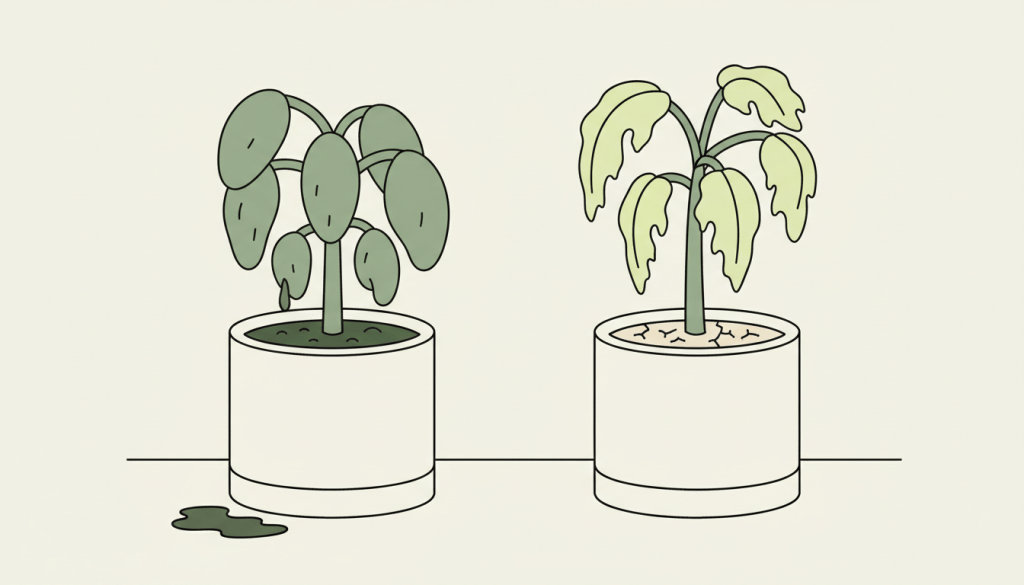
    Overwatered plants tend to have soft, yellowing or drooping leaves with soil that stays wet. Underwatered plants usually have dry, crispy, curling leaves and soil that is dry, sometimes pulling away from the pot edge. Leaves alone can mislead, because both problems can look similar. Check the soil and the weight of the pot first.

    Overwatered vs underwatered: side-by-side symptoms

    Both problems can cause yellowing, drooping and leaf drop, so no single leaf symptom settles it. Use the table as a guide, then confirm with the checks in the next section.

    What you seeOften overwateredOften underwatered
    Leaf feelSoft, limpDry, crisp
    Leaf colourYellowing, often on lower or inner leaves first; browning that starts in the leaf middleYellowing or scorched look; brown tips and edges
    Drooping and leaf dropDroops even though the soil is wet; leaves drop laterDroops because the plant is short of water; leaves may curl
    SoilStays damp, may look dark or slimyDry, pale, may crack or shrink from the pot wall
    Pot weightHeavyNoticeably light
    RootsBrown or black, mushy, may smell sourCan look rusty or light brown

    Brown tips are only a hint. Low humidity, fertiliser salt build-up and drafts can cause them too. If yellow leaves are your main worry, see yellow leaves on houseplants.

    How to confirm in 60 seconds

    Run these four checks in order. Together they take about a minute.

    1. Finger test

    Push a finger into the soil about 1-2 in (2.5-5 cm) deep. In a large pot, go deeper, because the surface dries first. Dry means thirsty; damp or wet means water is not the missing ingredient. For more detail, read how to tell if a plant needs water.

    2. Lift the pot

    A dry pot feels clearly lighter than a freshly watered one. If it feels heavy, wait before watering again. Lift it right after a proper watering once, so you know what “heavy” feels like for that plant.

    3. Check drainage

    Look for drainage holes in the base. Check whether water is standing in the saucer or in a decorative outer pot. Pots with no holes make overwatering and rot more likely, and decorative covers can trap water out of sight.

    Also watch how water behaves when you pour it. If it runs straight out of the bottom without soaking in, the soil may be too dry to absorb it (see the special cases below).

    4. Look at the roots

    If the first three checks do not settle it, slide the plant out of its pot. Healthy roots are pale (white to light tan), firm and have no smell. Rotted roots are brown or black, mushy or slimy, and may smell foul.

    Quick decision list

    • Dry soil, light pot, crispy leaves: underwatered.
    • Wet soil, heavy pot, soft or yellow leaves: overwatered.
    • Wet soil but the plant is wilting: suspect root damage. Waterlogged roots struggle to take up water, so the plant can look thirsty while the soil is wet. Do not add more water. See why is my plant drooping.

    How to fix an overwatered plant

    1. Stop watering. Let the soil dry out until the top 1-2 in (2.5-5 cm) is dry.
    2. Empty the saucer and any outer pot so roots are not sitting in water.
    3. Check the roots if the soil stays wet or the plant keeps declining. Remove damaged or diseased roots and keep as much living root as you can.
    4. Repot into fresh, well-draining mix in a pot with drainage holes.
    5. Water only when the soil tells you to, not on a fixed day.

    Recovery depends on how much healthy root remains. If some healthy roots remain, the plant can recover, but damaged leaves do not regrow. For rot that has spread, read root rot in houseplants, or the wider guide on how to save a dying houseplant.

    How to fix an underwatered plant

    1. Water thoroughly, pouring slowly until water runs out of the drainage holes. Letting it run for about a minute helps the whole root ball get wet.
    2. Empty the saucer after the pot has drained, within about an hour.
    3. If the soil is bone dry and repels water, stand the pot in lukewarm water until the bubbles stop rising, then let it drain. Our guide to bottom watering plants walks through it.
    4. Be patient with very dry mix. It may need several rounds of watering before it holds moisture again.
    5. Trim badly crisped leaves if you like. They will not recover.

    Do not flood a dried-out plant over and over to “catch up”. Soak it properly once, then return to checking the soil. Recovery varies by plant and by how long it was dry.

    Special cases that confuse the diagnosis

    Succulents and cacti

    Wrinkled or shrivelled leaves usually point to thirst, especially when the pot is light and the soil is dry. Overwatering damages roots and causes rot, and soft, mushy leaves can go with it. The catch is that rot can also make leaves wrinkle and look thirsty, so always check the soil and the base of the plant before reaching for the watering can. In winter rest, succulents need only enough water to stop shrivelling.

    Drought-tolerant plants

    Some plants cope with drier soil than others. Check your plant’s own care guide, and test the soil before every watering.

    Root-bound plants

    A plant that dries out unusually fast may be pot-bound. A dense mass of roots leaves little soil to hold water, and water can run past a dry core. Look for roots poking through the drainage holes or circling the root ball. If so, repot into a pot only slightly larger, about 2 in (5 cm) wider.

    Hydrophobic soil and dried-out potting mix

    Mix that has dried out completely can shrink from the pot wall and resist rewetting. Water then runs down the sides and out of the bottom, leaving the root ball dry. Peat-based mixes in particular can behave this way once they dry thoroughly. Soaking the pot from below usually fixes it.

    Winter slowdown

    Indoor plants often grow more slowly in winter, so they usually need less water, and watering as normal can lead to rot. Some plants go dormant. Do not assume the soil always dries slower, though, since plants near heaters can dry faster. Check the soil, not the calendar.

    How to avoid both problems

    • Check the soil, not the date. Water when the top layer is dry for that plant type. Our guide to how often to water houseplants covers the details.
    • Use pots with drainage holes and empty saucers after watering.
    • Pick the right pot size. An oversized pot holds water for too long. Step up only about 2 in (5 cm) at a time.
    • Use a well-draining mix suited to the plant.
    • Water thoroughly, then let the soil dry as that plant prefers.
    • Adjust by season. Expect to water less when growth slows.
    • Use a moisture meter with care. The top dries first, so take readings about a quarter of the way down and near the bottom.

    Care needs vary with light, temperature and humidity, so treat any watering range as a starting point.

    Plant-specific guides

    Some plants show these problems in their own way:

    • Pothos leaves turning yellow
    • Monstera leaves turning yellow

    FAQ

    Can an overwatered plant recover?

    Often, yes, if some healthy roots remain. Stop watering, let the soil dry, and repot into fresh mix if rot is present. Damaged leaves will not return to normal.

    Do overwatered and underwatered plants both have yellow leaves?

    Yes. With overwatering, yellow leaves tend to be soft and the soil is wet. With underwatering, yellow or brown leaves tend to feel dry and crisp, and the soil is dry. See yellow leaves on houseplants for other causes.

    Why is my plant drooping when the soil is wet?

    Roots sitting in waterlogged soil can be damaged and unable to take up water. The plant then droops even though water is plentiful. Check the roots and drainage, and read why is my plant drooping.

    Should I water a wilting plant straight away?

    Not before checking the soil. If it is dry, water thoroughly. If it is wet, more water will make things worse.

    How long does an underwatered plant take to perk up?

    It varies with the plant and how dry it became. Crisped or scorched leaves will not recover.